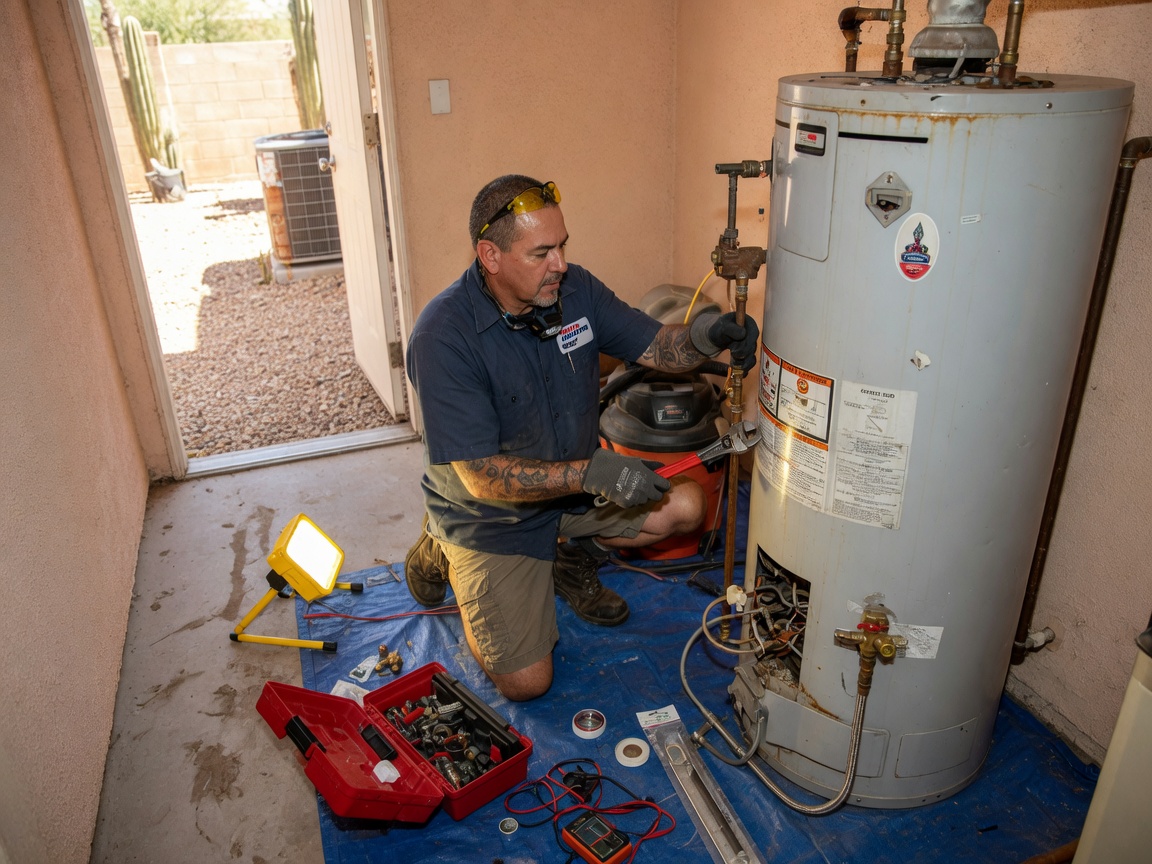
Phoenix summers push water heaters hard. Extreme heat outside combined with constant indoor use means sediment builds faster in tanks, especially in homes built in the 1970s and 1980s that still stand in Biltmore and Arcadia. Technicians see failed thermostats and burned elements more often here than in milder climates because the units rarely get a break.
Maricopa County water carries higher mineral content that coats heating elements and shortens anode rod life. In South Phoenix and Maryvale neighborhoods, older galvanized lines feeding the heater can add rust particles that accelerate tank corrosion. A repair call often turns into checking the full inlet line rather than just swapping a part.
Gas models common in Camelback East require careful venting checks after any control valve work because desert dust collects on burners. Electric units in newer Ahwatukee builds sit in garages that reach 110-plus degrees, so upper and lower element failures happen together. Technicians carry both 4500-watt and 5500-watt elements on every truck to match what is already installed.
Technician insight
In Phoenix the thing that catches most people out with water heater repair is how fast sediment and scale collect because of our extreme summer heat and mineral-heavy water. Homes in Maryvale and South Mountain from the 1980s often need the inlet line flushed at the same time or the new element fails again within months.
No Hot Water in Biltmore Home
Homeowner in a 1982 Biltmore residence reported sudden loss of hot water during a July heat wave. Technician found both electric elements shorted from heavy sediment. After flushing the tank and replacing the elements and upper thermostat, hot water returned and the unit was left running at 120 degrees.
Water Heater Repair Services We Offer
✓Electric Element Repairs
Replace burned upper or lower elements on electric tanks common in Phoenix homes. Service includes testing thermostats and verifying 240-volt supply before leaving.
✓Gas Control Valve Repairs
Repair or replace faulty gas valves on natural gas and propane heaters found throughout Biltmore and Camelback East. Includes leak testing and pilot assembly inspection.
✓Thermostat Replacement
Install new upper and lower thermostats on electric units to restore accurate temperature control in extreme summer conditions.
✓Anode Rod Inspection and Replacement
Check and swap magnesium or aluminum anode rods to slow tank corrosion caused by Phoenix hard water.
✓Residential Water Heater Repair
Diagnose and fix leaks, no-hot-water issues and temperature fluctuations on standard 40- to 80-gallon tanks in single-family homes.
✓Commercial Water Heater Repair
Service larger capacity units in restaurants and small businesses across Phoenix and Tempe with minimal downtime.
Water Heater Repair Cost in Phoenix, AZ
| Service | Typical Range | What Affects It |
|---|---|---|
| Electric element replacement | $200–$450 | Price rises with dual-element jobs or difficult garage access in Ahwatukee |
| Gas control valve replacement | $275–$550 | Higher when venting or pilot assembly also needs work |
| Thermostat replacement | $150–$300 | Both upper and lower thermostats often replaced together |
| Anode rod service | $175–$325 | Includes draining and flushing sediment common in Phoenix water |
Ranges are typical for Phoenix, AZ and confirmed with an exact written quote before any work starts.
How it works
- 1
24-Hour Dispatch
Answer the call, confirm location in Arcadia, Ahwatukee or another Phoenix neighborhood, and send the nearest technician.
- 2
On-Site Diagnosis
Shut off water and power or gas, drain the tank if needed, and test elements, valves and thermostats.
- 3
Repair or Part Replacement
Install correct replacement parts matched to the existing model while checking venting and supply lines.
- 4
System Test and Cleanup
Refill, restore power or gas, verify temperature and pressure, then remove old parts and water.
Pricing
Upfront quotes given on site before repairs begin; prices vary by part availability and access in older Phoenix homes.